
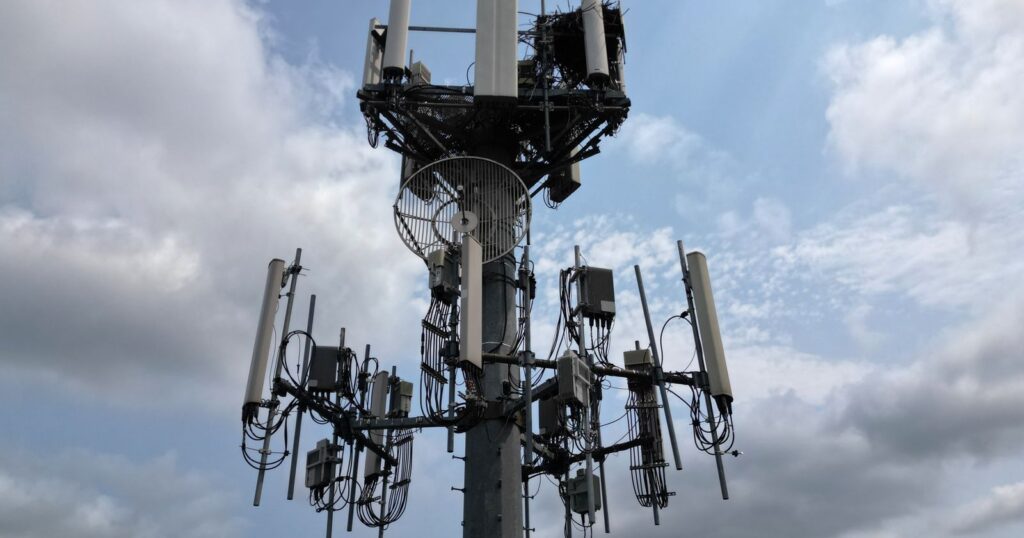
A private 5G network is a cellular network dedicated to one organisation’s site, such as a factory, warehouse, port, mine or campus. It complements Wi-Fi where mobility, coverage or deterministic performance are critical.
Where private 5G fits
- Manufacturing: connected machinery, automated guided vehicles and sensors.
- Logistics and ports: large outdoor areas with moving equipment.
- Mining and energy: remote sites with challenging environments.
- Campuses and venues: reliable coverage across large areas.
Private 5G and Wi-Fi
Wi-Fi remains cost-effective for offices and laptops. Private cellular offers wide-area coverage, seamless mobility across large sites and more predictable performance for critical machines. Many sites use both.
Considerations
- Spectrum: availability depends on country — options include licensed, shared or locally licensed spectrum.
- Deployment model: operator-managed, managed service or self-operated.
- Devices: check that sensors and equipment support the required bands.
- Integration: connection to enterprise IT, OT and security systems.
- Skills: cellular networking expertise may need to be bought in.
5 proven use cases for private 5G
- Smart manufacturing. Reliable, low-latency connectivity for mobile robots, automated guided vehicles and machine sensors.
- Ports and logistics. Wide-area coverage for cranes, vehicles and tracking across large outdoor yards.
- Mining and energy. Connectivity in remote or hazardous sites where fixed networks are impractical.
- Campuses and venues. Dedicated capacity for operations, security and staff communications in crowded environments.
- Healthcare. Secure connectivity for medical equipment, asset tracking and mobile workflows.
Best practices for deployment
- Start with a clear business case and measurable outcomes, such as reduced downtime or improved safety.
- Understand spectrum options in your country, including shared, licensed or locally licensed spectrum.
- Check device ecosystem support for the bands you plan to use.
- Decide whether to build, buy a managed service or partner with a mobile operator.
- Integrate with existing IT and OT security, identity and monitoring systems.
Private 5G and Wi-Fi together
Most enterprises will use both. Wi-Fi remains cost-effective for offices and general user devices, while private 5G suits mobility, large outdoor areas, deterministic performance and mission-critical industrial applications.
Common mistakes to avoid
- Deploying technology before identifying use cases that justify it.
- Underestimating device costs and availability.
- Lacking in-house skills to operate cellular core networks.
Frequently asked questions
Is private 5G expensive?
Costs have fallen with managed and cloud-based core options, but radio planning, devices and integration remain significant.
Can private 5G connect to public networks?
Yes, depending on design, devices can roam to public networks or remain fully isolated.
A 90-day evaluation plan
Days 1 to 30: identify operational problems that better connectivity could solve, such as coverage gaps for vehicles or unreliable links for robots, and estimate their cost to the business.
Days 31 to 60: review spectrum options, compare build, managed service and operator partnership models, and check device availability for your use cases.
Days 61 to 90: run a small pilot in one area, measure coverage, latency and reliability, and build a business case for wider deployment.
Questions to ask providers
- Which spectrum will be used, and who holds the licence?
- Is the core network on-site, in the cloud or hybrid?
- Which industrial devices and sensors have been tested?
- How is the network monitored, and what are the service levels?
- How does it integrate with our existing security and identity systems?
Key terms explained
- Core network: the control and switching functions that manage cellular devices and traffic.
- Radio access network: the antennas and base stations that connect devices.
- Network slicing: creating logical networks with different performance on shared infrastructure.
- SIM provisioning: issuing and managing the identities devices use to join a cellular network.
The bottom line
Dedicated cellular networks are moving from experiments to production in factories, ports, mines and large campuses. They suit environments that need wide coverage, mobility and predictable performance for critical operations. The strongest projects start with a clear business problem, understand local spectrum rules, confirm device availability and decide early whether to build, buy as a service or partner with an operator. Combined with existing Wi-Fi, a well-planned deployment can unlock new levels of automation and safety.
Further reading on private 5G
For authoritative, vendor-neutral guidance on private 5G, see 3GPP. You can also browse our free whitepapers.